Skills That Matter More Than Grades
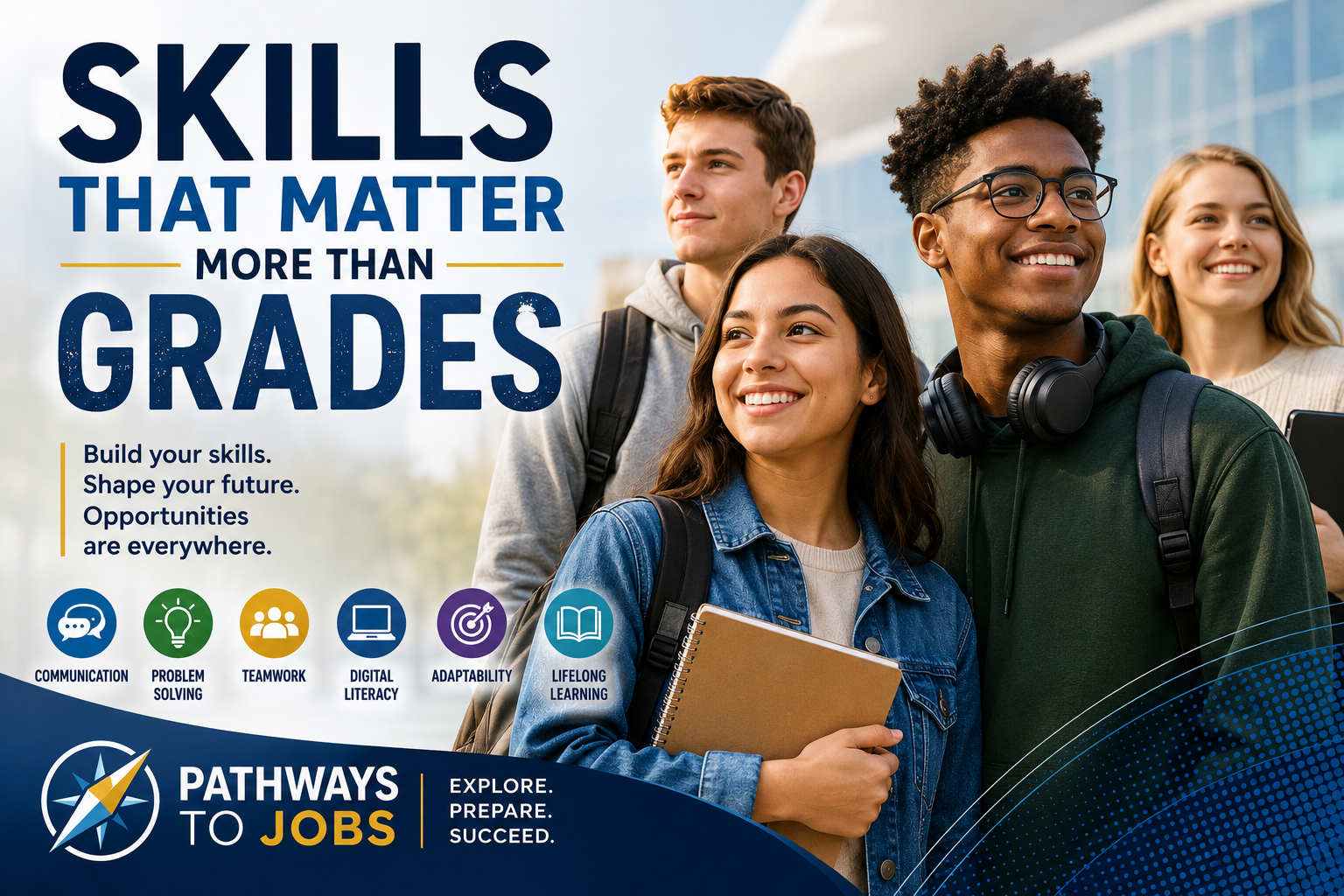
For generations, students have been told that good grades are the key to success. While education remains important, today's employers are looking beyond report cards and asking a different question:
Can this person learn, adapt, communicate, and contribute?
Grades can show what you've learned in a classroom. Skills demonstrate how you'll perform in the workplace.
As technology, artificial intelligence, and new industries continue to reshape the job market, employers are placing greater value on qualities that cannot always be measured by a test score.
Communication Matters
No matter the career path, healthcare, skilled trades, business, technology, or retail, communication remains one of the most important workplace skills.
Can you explain your ideas clearly? Can you listen and work effectively with others? Can you communicate professionally with customers, coworkers, and supervisors?
Strong communicators often stand out because they help teams work better together and solve problems more effectively.
Adaptability Is Essential
The workplace is changing faster than ever. New technologies are being introduced constantly, and many jobs continue to evolve.
Employers want people who can learn new skills, adjust to change, and remain positive when faced with challenges. The ability to adapt may be one of the greatest advantages a young person can develop.
Those who are willing to learn and grow will continue to find opportunities, even as industries change.
Problem Solving Creates Value
Every workplace faces challenges. Employers appreciate people who look for solutions instead of simply identifying problems.
Problem-solving skills involve critical thinking, creativity, and initiative. Whether you're helping a customer, improving a process, or finding a better way to complete a task, your ability to solve problems can make you an invaluable member of any team.
Reliability Builds Trust
One of the most overlooked workplace skills is reliability.
Showing up on time, meeting deadlines, following through on commitments, and taking responsibility when mistakes occur all demonstrate professionalism.
Many employers will choose a dependable employee over a highly talented but inconsistent one. Reliability builds trust, and trust opens doors to future opportunities.
Digital Literacy Is No Longer Optional
Technology plays a role in almost every industry. Understanding digital tools, online communication, and emerging technologies such as AI can provide a significant advantage.
Digital literacy doesn't mean becoming a programmer. It means being comfortable using technology effectively and responsibly to complete tasks and solve problems.
Lifelong Learning Wins
Perhaps the most important skill of all is the willingness to keep learning.
Graduation is not the end of education; it's the beginning. The most successful people continue developing new skills throughout their careers. They stay curious, embrace change, and look for opportunities to grow.
Final Thoughts
Grades still matter. They reflect effort, discipline, and academic achievement. But in today's rapidly changing world, employers are increasingly looking for something more.
Communication, adaptability, problem-solving, reliability, digital literacy, and a commitment to lifelong learning are the skills that help people succeed in the workplace and throughout their careers.
As students prepare for summer and think about their futures, it's worth remembering that success isn't determined solely by what's written on a report card. It's also shaped by the skills you build, the experiences you gain, and your willingness to keep learning long after school ends.
At Pathways to Jobs, we believe that education opens doors, but the skills you develop along the way help you walk through them.